HomeNavigation arrowBlogNavigation arrow
Current page
Photography Tips

The Hidden Cost of Shipping in Volume Photography

The Hidden Cost of Shipping in Volume Photography

by Jack Counts III - NowCandid Project Manager

‍

A photography business recently switched to NowCandid from another volume photography platform...

‍

During the transition, they shared some details about how their previous software handled shipping and fees.

‍

I knew different platforms approached this stuff differently. But seeing the mechanics laid out was one of those “wait… what?” moments.

‍

In the setup they described, the photographer didn’t set the shipping charge. They didn’t get any revenue from shipping charged to their end customer. But the amount charged for shipping still increased the percentage-based fees coming out of their payout.

‍

Which is honestly kind of wild to me.

‍

It got me thinking about two sides of the same problem: what shipping costs the photographer, and what it can cost them when a customer decides not to buy.

‍

What does that shipping charge actually cost the photographer?

‍

Some volume photography platforms use lab-set shipping rates for orders delivered directly to customers. GotPhoto’s documentation (help.gotphoto.com/en/support), for example, says its direct-shipping charges are determined by the lab and automatically added at checkout.

‍

That raises a separate question: Does that shipping charge also increase the percentage-based fees coming out of the photographer’s payout?

‍

PhotoDay’s published standard pricing (support.photoday.io/en/articles) applies its 10% ecommerce fee to the total order, including products, shipping, and tax. Its reporting guide (support.photoday.io/en/articles) says customer-paid shipping goes directly to the lab.

‍

Let’s use a hypothetical order: $50 in photo products plus $10 in shipping. The customer pays $60 before tax.

‍

A 10% ecommerce fee on the products would be $5. Applying that same fee to the $10 shipping charge adds another $1, bringing the total ecommerce fee to $6.

‍

That extra dollar might not sound like much. But it means the ecommerce fee consumes 12% of the photographer’s product sales, all while the photographer doesn’t keep any shipping revenue.

‍

That’s an additional two percentage points of product revenue going toward ecommerce fees because of shipping.

‍

Here’s how that changes across a $5–$20 shipping range:

‍

How shipping affects ecommerce fees on $50 in product sales
Customer's shipping charge 10% ecommerce fee on shipping alone Total ecommerce fee on products + shipping Effective fee as a share of $50 in product sales
$5 $0.50 $5.50 11%
$10 $1.00 $6.00 12%
$15 $1.50 $6.50 13%
$20 $2.00 $7.00 14%

Illustrative calculations assume $50 in product sales and a 10% ecommerce fee applied to products plus shipping. They exclude payment processing, sales tax, and fulfillment costs.

‍

Payment processing adds another layer. Under PhotoDay’s published 2.9% processing rate, that $10 shipping charge generates another $0.29 in fees. Combined with the $1 ecommerce fee, that’s $1.29 attributable to shipping alone, equivalent to 2.58% of the $50 in product sales.

‍

Across 1,000 orders like this, that adds up to $1,000 in ecommerce fees plus $290 in processing fees attributable to shipping.

‍

To be clear, processing a larger payment costs more. That isn’t surprising. What I’m questioning is an arrangement where the photographer doesn’t set the shipping charge or keep that revenue, yet still pays percentage-based fees on it. The higher the charge, the more those fees take from the sale.‍

‍

PhotoDay does let photographers offer free economy shipping as a promotion (support.photoday.io/en/articles). Its reporting guide (support.photoday.io/en/articles) explains that the shipping charge is then deducted from the photographer’s payout. That takes the charge off the customer’s plate, but the photographer still covers the lab-set amount.

‍

And then there’s the shipping rate itself.‍

‍

I’m looking at this from the print lab side, too. NowCandid charges photographers $1.80 to ship basic small-print orders, and that already includes our margin.

‍

For comparison, Richmond Pro Lab lists $5.25 shipping through PhotoDay (richmondprolab.com/s/article) for qualifying orders under $10 in lab product cost. Against our $1.80 basic small-print rate, that’s a $3.45 difference per order, or $3,450 across 1,000 qualifying orders, before accounting for selling fees.

‍

I’m not arguing that a lab shouldn’t make money. We do, too. What bothers me is that the photographer doesn’t get to set the shipping price or share in the shipping revenue, but still pays percentage-based fees when the customer covers that charge. And offering free shipping means absorbing the lab-set amount instead.‍

‍

Either way, the photographer has limited control over a cost attached to their own sale.

‍

High shipping costs can put the whole order at risk

‍

The photography business I talked with also told me that costs for expensive-to-ship items were passed entirely on to end customers at checkout.

‍

Say someone picks out a $70 product, then discovers shipping adds another $20. Their purchase just became almost 29% more expensive, before tax.

‍

Maybe they’re fine with that. Or maybe that’s the moment they close the tab.

‍

Baymard Institute’s checkout research (baymard.com/lists/cart-abandonment) lists high extra costs, including shipping, taxes, and fees, as the top reason shoppers give for abandoning checkout, cited by 40% of respondents. That’s general ecommerce research, not a photography-specific rate, but it’s a pretty compelling reason to pay attention to the shipping line.

‍

But covering fulfillment costs doesn’t mean every dollar has to appear in the shipping field. Consider two ways to price the same purchase:

‍

Same $90 total, different shipping prices
Price breakdown Higher shipping Lower shipping
Product price $70 $85
Shipping $20 $5
Total before tax $90 $90

Hypothetical pricing example. Both options total $90 before tax; the difference is how the price is divided between the product and shipping.

‍

Same total. Different presentation.

‍

There’s research suggesting that distinction matters. A 2026 study in PLOS ONE (journals.plos.org/plosone) found a preference for free shipping even when the total purchase price stayed constant. It was a small study, but it gives us a reasonable question to test: Would customers respond better if more of the fulfillment cost were included in the product price and less appeared as shipping?

‍

For some broader context, Baymard Institute’s compilation of 50 studies (baymard.com/lists/cart-abandonment) puts average online shopping cart abandonment at roughly 70%. That’s about seven out of ten carts that never become completed purchases.

‍

In our recent internal data, NowCandid has seen roughly 3 abandoned carts for every 100 completed orders. Only about 3%!

‍

General online retail isn’t the same as volume photography, of course, and those numbers don’t prove that NowCandid’s focus on low shipping is responsible for the difference. But it’s an encouraging result! Giving your customers fewer reasons to reconsider at checkout is something we take seriously. 😎

‍

How NowCandid gives photographers more control

‍

With NowCandid, photographers can set their customer-facing shipping prices (nowcandid.com/blogs), rather than simply passing through a lab-set charge. They can also price shipping above the underlying cost to create additional margin.

‍

But having the opportunity to profit from shipping doesn’t mean you should always charge more for it.

‍

You can keep shipping very inexpensive and account for more of the fulfillment expense in your product pricing instead. That’s especially useful when you’d rather not put a large delivery charge in front of someone buying a more expensive item.

‍

We also don’t calculate our ecommerce or payment-processing percentages on collected sales tax (nowcandid.com/blogs). Collecting tax and charging additional fees on those tax dollars are two separate things.

‍

It’s about more than cheaper shipping

‍

Looking back at that conversation, what bothered me wasn’t simply that one shipping charge was higher than another. It was how little control the photographer had over something that affected both their profit and their customer’s experience.

‍

Shipping has a real cost. So does running a lab. But how that cost is priced, presented, and used to calculate fees deserves a closer look.

‍

When comparing volume photography software, I’d ask: Who sets the shipping price? Who receives that money? What fees are calculated on it? And can you change the offer your customer sees?

‍

The advertised ecommerce percentage only tells part of the story.

‍

There isn’t one perfect shipping strategy for every photography business. That’s exactly why I’d rather give photographers more room to choose their own.

‍

Shipping is part of your pricing. You should get a say in it.

‍

Thank you for attending my TED talk 🙏

Jack Counts III

NowCandid Project Manager

‍

NOTE: Platform examples reflect published policies and standard rates reviewed September 25, 2026. Terms can vary by lab, plan, promotion, or agreement. Order examples are illustrative, not reported studio results.

Related articles

Weekly Recap: Overlay Artwork in the Product Gallery 🎨✨
Feature Updates
January 3, 2025

Weekly Recap: Overlay Artwork in the Product Gallery 🎨✨

2
 minutes read
Hello again, my wonderful photographers!

‍

Candy here, and welcome to another Weekly Recap. This time, we’ve got one exciting improvement to share—overlay artwork now appears by default on product previews in the product gallery!

‍

Let’s take a closer look. 🌟

‍

Overlays Rendered by Default in Product Gallery 🎉

‍

We’ve introduced a fun change for anyone using Banner Overlays or Full Frame Overlays in their NowCandid Events:

‍

  • Visible Overlay Art
    ‍

    Items in the retail site’s product gallery will now display your Event’s overlay artwork right away. Customers can see exactly how their images look on each product, with that extra creative touch of your Event's Overlay Art.

‍

Theme: Marshmallow - Watermarking: Heavy

‍

Theme: Liquourice - Watermarking: None

‍

  • Use Overlay by Default
    ‍

    When customers go to customize or add a product to their cart, the “Use Overlay” option will already be selected. This makes it simpler to highlight your unique event designs or branding. But they can still view & order the product without the overlay art.
    ‍
  • Easy Toggle in Settings
    ‍

    If you prefer to keep products overlay-free by default, no worries! Head to the “Retail Site Settings” in your Profile and uncheck “Use Artwork By Default.” That way, product images will display without your Event overlay art unless customers choose otherwise.

‍

Find this option in your Profile settings

‍

Enabling Use Artwork By Default will feature your Event's Overlay Art on the renders in the product gallery page. Guests can choose to view and order products without the art, but "with overlay art" will be the default selection.

‍

That’s all for this week’s short-and-sweet recap!

‍

We hope this feature adds a little extra flair to your retail experience.

‍

As always, let us know what you think or if you have any feedback.

‍

Candy 🍬

Big News: Introducing Photo Booth Mode in iOS Capture & Upload App 4.13! 🎉
Feature Updates
December 30, 2024

Big News: Introducing Photo Booth Mode in iOS Capture & Upload App 4.13! 🎉

6
 minutes read
Hello, my wonderful photographers!

‍

Candy here with exciting news for you on this festive Monday. We’re launching Capture & Upload App Version 4.13, and it comes with a massive new feature: Photo Booth Mode.

‍

Let’s dive into what it is, how it works, and why we think you’ll love adding it to your events!

‍

What Is Photo Booth Mode? 🤳

‍

Photo Booth Mode is a brand-new option inside the Capture & Upload App (Version 4.13 on iPad). When you log in to your Event, you’ll see a shiny new “Photo Booth” button alongside the usual options.

‍

Tap that button, and your iPad transforms into a fun, self-serve photo booth station, perfect for:

‍

  • Weddings & Parties: Encourage guests to capture memorable group shots and instantly send them to their phones.
    ‍
  • Sports & Corporate Events: Provide interactive experiences that keep people engaged and excited.
    ‍
  • Holiday Gatherings: Add some festivity and help guests create themed keepsakes right on the spot.

‍

Whether you tether a Nikon, Sony, or Canon camera or just use the iPad’s built-in camera, Photo Booth Mode gives you a convenient, autonomous way to let guests take pictures without any manual work from you (aside from set up and takedown of course).

‍

How It Works ⚙️

‍

  1. Tap to Begin Screen
    ‍
    • Guests see a dimmed live view with “Tap to Begin.” Once tapped, the booth takes three pictures in quick succession, each with its own 3-second countdown.
      ‍
  2. Real-Time Overlays
    ‍
    • If your event has Bottom Banner Overlays or Full Frame Overlays, they appear in the live view. This lets guests see exactly where the art will sit, so no one’s face gets covered.
      ‍
  3. On-Device Styling
    ‍
    • Background Removal & Custom Backgrounds: If you’ve uploaded backgrounds for your event, they’ll be available for selection.
      ‍
    • Filters: Guests can apply classic filters like Noir, Sepia, or Clarendon before sending off their images.
      ‍
    • Reshoot: Not happy with a pose? Subjects can tap “Reshoot” and start over, easy-peasy.
      ‍
  4. Instant Delivery
    ‍
    • Both FreePics or PartyPics Workflows deliver images in real time:
      ‍
    • If it’s FreePics, your subjects will get the image files directly via MMS, with Overlay Art applied, if your Event has any. They'll also receive a link to their personal gallery. Reminder, with FreePics we charge a small fee per uploaded image.
      ‍
    • It it's PartyPics or any of our other Programs, your subjects will only receive a link to their personal gallery. And there is no additional charge or fee.
      ‍
    • When visiting their personal gallery, they can buy prints & downloads of these images with various product & customization options.
      ‍
  5. Positive ID vs. Face Matching
    ‍
    • Face Matching: Prompts appear to tap faces, then gather contact info for those individuals.
      ‍
    • Positive ID: Participants just enter their info before sending images, no face-tapping required.

‍

All images are uploaded to your NowCandid Event like normal, so no matter your usual Workflow, things will still function seamlessly!

‍

Key Requirements & Limitations ⚠️
‍

  • Camera Orientation
    ‍
    • Nikon cameras support both horizontal and vertical orientation.
      ‍
    • Sony and Canon are currently limited to horizontal orientation.
      ‍
  • iPad-Only Launch
    ‍
    • Photo Booth Mode works on iPad (and only in vertical orientation), not on iPhone or Windows at this time.
      ‍
  • No Built-In Strip Printing
    ‍
    • If you need to provide prints, set up a separate print station and use quic.pics/portal to download images with or without Event Overlay Art and print them on-the-spot!
      ‍
  • Strong Internet Connection
    ‍
    • Ensure your iPad has solid Wi-Fi or LTE, as the app needs to log into the event, download overlays/backgrounds, and upload images in real time.

‍

Why You’ll Love Photo Booth Mode ❤️

‍

  1. Interactive Fun
    ‍

    Guests choose their own backgrounds, overlays, and filters, creating a memorable activity at any gathering.
    ‍
  2. Seamless Feature Integration
    ‍

    Images will show up in LiveLoop slideshows, appear alongside subject's other images in Personal Galleries, be managed using NowCandid's typical image and participant management tools, and more!
    ‍
  3. Seamless Workflow Integration
    ‍

    The images flow right into your existing event Workflows—Tap-A-Face, Selfie Check-In, Type & Take, and more—without any additional setup.
    ‍
  4. Effortless Setup
    ‍

    Whether you opt for a tethered DSLR or the iPad camera, it’s a simple tap away in Capture & Upload App 4.13.

‍

Download Capture & Upload App 4.13 Today! 📱

‍

With Version 4.13 now live for iPad (iOS only at the moment), you can start offering Photo Booth Mode at your next event.

‍

We’ve tested it extensively, but with so many different devices and use cases out there, we encourage you to try it out ASAP.

‍

If you spot any quirks, let us know, and we’ll work on improvements swiftly.

‍

Thank you for joining us in this Big News blog post.

‍

We can’t wait to hear your success stories with Photo Booth Mode!

‍

Candy 🍬

Weekly Recap: Group Photos for Grads & Retail Download Tweaks📸🎉
Feature Updates
December 27, 2024

Weekly Recap: Group Photos for Grads & Retail Download Tweaks📸🎉

7
 minutes read
Hello, my wonderful photographers!

‍

Candy here, and welcome to another Weekly Recap. We’ve got a couple of handy feature updates, plus some exciting news about our upcoming Capture & Upload App release for iOS.

‍

Let’s dive in! 🌟

‍

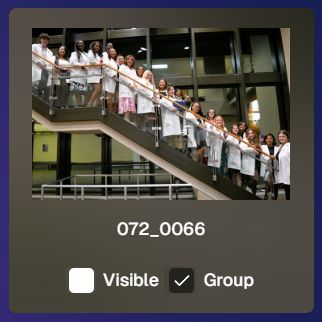
1. Group Photo Option in GradPics 📸

‍

We’ve introduced a Group Photo toggle in the Manage Images tab for GradPics Events. When you mark an image as a Group Photo, here’s what happens:

‍

  • Appears in Every Gallery: Regardless of face matching, every participant sees the group image in their personal gallery.
    ‍
  • Exclusive Products: If your Event’s Offer includes any Group Photo products (like Group Photo Download or Group Photo Print), they’ll only be purchasable on those items.
    ‍
  • No Group Photo Products? Then the group image behaves like a normal image, available on all your usual products.
    ‍
  • Not in Personal Gallery Download: To avoid easy sharing of a big group image, we’re excluding Group Photos from any personal gallery download product for now.

‍

‍

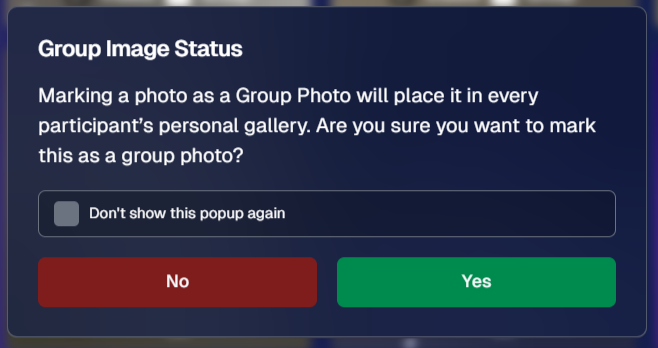
We’ve added a quick popup explanation when flagging an image as a Group Photo in the Web Dashboard, just in case someone clicks the Group Photo toggle by mistake. 🎉

‍

‍

2. Personal Gallery Download Hiding Rule 🤫

‍

To help clients avoid confusion and refunds, we’re adding a new rule:

‍

  • Hide Personal Gallery Download: If the Offer sells individual image downloads and a participant only has one image, we hide the personal gallery download.
    ‍
  • Still Visible for One-Image Events: If your Offer doesn’t have individual downloads, the personal gallery download stays visible, even if the participant just has one photo.

‍

This little tweak prevents clients from accidentally buying a personal gallery download when they only need a single download. 🛒

‍

3. Heads-Up: Capture & Upload App 4.13 for iOS Only! 📱

‍

On Monday, December 30th, we’ll release Version 4.13 of the Capture & Upload App for iPhone & iPad. (Windows stays at 4.12 for now.) We’ve added some major updates:

‍

Please update one of your devices, test it out, and let us know if you catch any bugs. With so many devices, camera brands, and workflows out there, early feedback helps us fix issues quickly.

‍

4.13 Highlights

‍

  1. Photo Booth Mode
    ‍
  2. Overlays on Capture App Image Review
    ‍
    • Overlays now render directly over the captured images on the app (if the aspect ratio is supported).
      ‍
    • 3:2 aspect ratio photos are needed for full frame overlays, but any aspect ratio works for banner overlays.
      ‍
    • This lets you and your subjects see the art in real time, ensuring no important parts are covered!
      ‍
  3. Out-of-Space Error Popup
    ‍
    • If your device is running low on space when a new image is taken, you’ll get an immediate error popup.
      ‍
    • Remember to regularly clear out old images via the app’s “Delete App Data” button in the info (i) menu to keep everything running smoothly.

‍

Minor Updates

‍

  • Session data is now wiped when switching NowCandid accounts in the app, so "Restore Session" won't take you to an Event from a different account!
    ‍
  • Event Shooting Buttons on Tablets now match iPhone UI (centered vertical menu).
    ‍
  • Camera Trouble Popup includes a note about app permissions. (Always make sure to agree to all app permissions needed when the app is starting for the first time!)
    ‍
  • Auto Remove Spaces from the account email on login. (some folks accidentally put a space and didn't know why they couldn't log in!)
    ‍
  • Candy Splash Screen when the app is booting up now supports dark mode.

‍

Thanks for tuning into this shorter Weekly Recap. We hope these improvements help you finish the year strong! If you have any questions or feedback, don’t hesitate to reach out.

‍

Candy 🍬

Let’s get in touch

If you’re a photographer looking to add NowCandid™ services to your wheelhouse, set up a call with us!

How to customize formatting for each rich text

How to customize formatting for each rich text

How to customize formatting for each rich text

How to customize formatting for each rich text

How to customize formatting for each rich text

‍

‍

What’s a Rich Text element?

The rich text element allows you to create and format headings, paragraphs, blockquotes, images, and video all in one place instead of having to add and format them individually. Just double-click and easily create content.

A rich text element can be used with static or dynamic content. For static content, just drop it into any page and begin editing. For dynamic content, add a rich text field to any collection and then connect a rich text element to that field in the settings panel. Voila!

Headings, paragraphs, blockquotes, figures, images, and figure captions can all be styled after a class is added to the rich text element using the "When inside of" nested selector system.

  • List One
  • List Two
  • List Three
  • List Four
  • List Five

This is a link

This is bold text

‍

  • ‍

‍